
The Beginner's Guide to Choosing a Sketchbook for Mixed Media
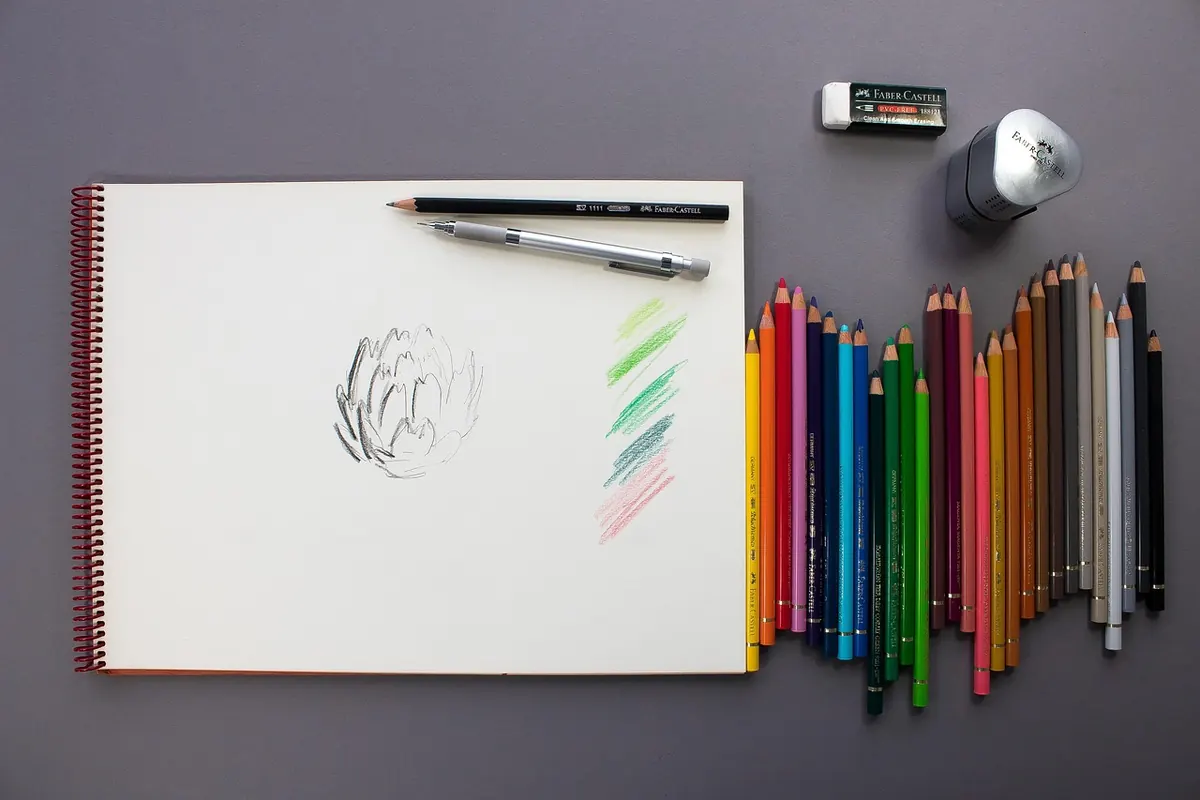
Walk into any art supply shop and the sketchbooks all look capable of the same thing. They are not. A book that takes a fountain pen beautifully can buckle under a single wash of watercolor, and a heavyweight watercolor block can feel like drawing on sandpaper with a soft graphite pencil. Choosing well comes down to knowing what you actually put on the page, then matching four things: paper weight, surface texture, binding, and size. Get those right and the book disappears from your attention, which is exactly what you want.
Start With an Honest Inventory of Your Mediums
Before you compare anything, make a list of what normally ends up in your sketchbook. Not what you hope to use someday — what you actually reach for on a Tuesday night.
Most people who describe themselves as mixed media artists mean one of two very different practices. The first is dry work with occasional accents: graphite, colored pencil, fine liner, marker, a little collage, maybe a light wash of watercolor. The second is genuinely wet work: saturated washes, acrylic, gesso, ink sprays, glued papers, scraping and sanding. The first group can comfortably use a mid-weight book. The second needs paper that behaves more like a watercolor sheet than a notebook page.
If you are unsure, ask yourself one question: do I ever want the paper to stay flat while it is wet? If the answer is yes, weight matters more than anything else on this list.
Paper Weight: The Number That Predicts Buckling
Paper weight tells you how much moisture and abuse a sheet can take before it cockles — that rippled, wavy look that ruins a clean drawing. You will see it listed in grams per square meter (gsm) or in pounds (lb), and the two scales are not interchangeable, so pick one and stick with it.
The rough ranges below cover most sketchbooks on the shelf:
- Around 90–120 gsm: sketch and drawing paper. Fine for pencil, ink, and light marker. Water will bleed through to the next page and wrinkle the sheet.
- Around 150–200 gsm: usually labeled "mixed media." Handles marker, colored pencil, light washes, and collage without much fight.
- Around 250–300 gsm and up: watercolor and heavy mixed media territory. Takes wet washes, masking tape, gesso, and scraping. Often the same weight front and back, so you can work on both sides.
Heavier is not automatically better. A thick book costs more, weighs more, and is harder to carry. If you draw with pencil and ink ninety percent of the time, an extra-heavy book just means you paid for absorbency you never use.
Texture: How the Surface Shapes Your Marks
Paper texture, sometimes called tooth, decides how your marks sit on the page. The three terms you will run into most are cold press, hot press, and rough.
Cold press
The middle ground, with a visible but gentle grain. Watercolor pools and granulates nicely, pencil grips well, and ink lines stay reasonably crisp. For a mixed media book, this is the safest default.
Hot press
Smooth and almost glossy to the touch. Wonderful for detailed pen work, fine colored pencil layering, and clean washes. It also shows every fingerprint and every hesitation, which some artists love and others find unforgiving.
Rough
Heavy texture that scatters pigment and creates sparkle in watercolor. It devours fine pencil detail and makes writing difficult. Buy it deliberately, for a specific look.
Also check whether the paper is sized. Sizing is a treatment that slows how quickly the sheet absorbs liquid. Well-sized paper gives you time to move paint around; unsized paper grabs the first stroke and refuses to let go.
Binding: Where Cheap Books Give Themselves Away
Binding is the part beginners ignore and then regret. A book that will not lie flat is a book you stop using.
Spiral and wire-o lay flat, let you fold the cover behind the pages, and make scanning simple. The trade-off is that pages can tear out at the holes, and the wire can dent in a bag.
Stitched signatures and Coptic bindings also lie flat, feel substantial in the hand, and hold up over years. You cannot remove a page cleanly, so if you like to pull out finished drawings, this is not the book for you.
Case-bound and glued spines look the most like a real book and often have the nicest covers. Many do not lie flat, and wet media near the gutter can crack the spine or seep into the binding. If you work wet, test how far the book opens before you commit.
Two smaller details worth checking: whether the pages are perforated, and whether the cover is stiff enough to draw on standing up.
Size and Format: The Choice You Feel Every Day
A 300 gsm book with a hundred pages is a brick. That is fine on a studio table and miserable in a backpack, and the sketchbook you leave at home is the one that stays empty.
If you sketch on the move, look at A5 or 5.5 × 8.5 inches — small enough for a jacket pocket, large enough for a real composition. Studio work benefits from A4 or larger, where a full arm movement is possible. Square formats encourage centered, graphic compositions; landscape books suit panoramas and long horizontal studies. If you plan to scan and share your pages, portrait orientation tends to be easiest to handle.
A Five-Minute Test Before You Buy
Standing in the shop, do this:
- Open the book to the middle and press it flat. If it resists hard, it will resist every day.
- Wet a fingertip and rub a back page. If the surface pills or sheds fibers, it will do that under paint too.
- Read the label for weight and whether it says acid-free. Acid-free paper will not yellow as quickly over time.
- Run a thumbnail across the surface. Too smooth and pencil slides; too rough and detail breaks up.
- Weigh it in your hand and picture carrying it for an hour.
Tip: when in doubt, buy the smaller book in the heavier paper. You will finish it faster, learn what you actually need, and waste less paper on experiments that were never going to work.
Make the First Book a Test, Not a Commitment
No single sketchbook suits every medium, and the artists who seem effortlessly productive usually keep two or three going at once: a light one for pencil and pen, a heavy one for wet work, and sometimes a cheap one for nothing in particular. Start with one book that matches your real habits, work a test spread on the first two pages — a wash, a swatch of each medium, a note about how it dried — and treat the rest of the book as information. By the time you reach the last page, you will know exactly what to buy next, and you will buy it with confidence instead of hope.
Photo: stux / Pixabay